How to Tell Weak Desire from Strong Desire

Does your desire create enough spark to jump the gap from inspiration to action? Not all desire is created equal. There are weak desires and strong desires. Weak desires are more easily slowed or deflected by conflicting beliefs or short-term challenges. Strong desires will help us seek the alignment and focus we need to make the jump from dream to reality.
A strong desire is something that comes from your essential nature, and that is intimately connected with your individual preferences, abilities, and purpose. We’ll call this kind of strong desire “self-connected.”
Self-connected desires have a “why” that is motivated from the inside out.
A weak desire is something you do in order to comply with something outside you that you buy into just enough to recognize that it serves you at least SOME of the time. The inspiration for such a desire is also weak, because it is about complying to avoid creating a gap, and not about filling a gap you want to fill. If the inspiration is weak, so is the desire. (Please see the post before this one for an explanation of the relationship of inspiration to desire.)
How Inspiration Creates Desire
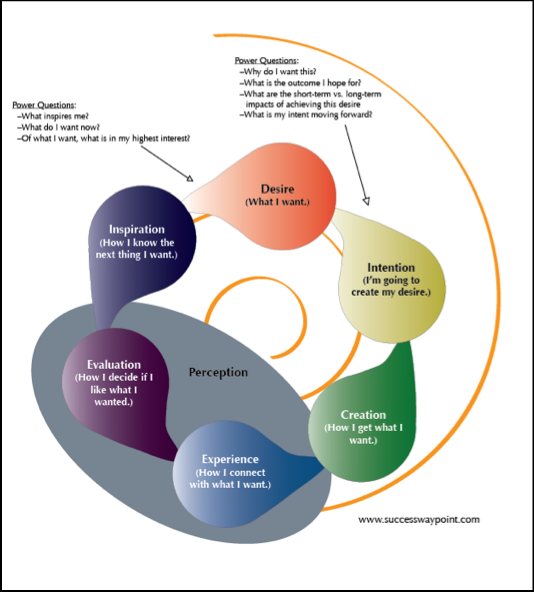
There was a time in the early-80’s when, in spite of the three cups of coffee I’d consumed in less than an hour, I quite literally was having trouble keeping my eyes open sitting at my desk at the sales job I had—and this went on for weeks.
I thought I wanted out, but we already had a 15-month-old and Sue was pregnant with another, and my logical mind told me that the lucrative job I held was one I ought to keep—in spite of the fact that my body was telling me otherwise.
I was bored silly and felt trapped, but the desire to keep a relatively reliable income stream overrode the desire to try something new. Bringing another life into the house was a big enough change, and I didn’t want to introduce another.
But It’s no fun to do stuff you don’t buy into or like, and doing stuff that bores you or that you don’t like for too long—without some kind of coping strategy—can have negative effects on both psychological and physical wellbeing. It wasn’t long before my discomfort inspired the desire to seek new employment—the balance of desire had shifted.
How Love Makes a Leader a Leader

Free Download, "Leadership as Connection" (Link at the End of this Post)
I’ve always thought that there was more to work than the work. We give our work meaning. Without the meaning we give to it, work seems like just “moving stuff around.” This is true whether that "stuff" is ideas or services or widgets or widget parts. When we get too serious about the moving stuff around part, and don’t balance that with the human-value part in the equation, well, work’s not as fulfilling or fun (and make no mistake, fulfillment and fun are big parts of employee engagement).
What’s love got to do with it? Love makes a leader a leader.
~Lucira Jane Nebelung
Sure, whatever we do serves others, and creates new opportunity, and creates value. Nevertheless, that value is quite literally undeliverable unless there is a “someone” to perceive it, and receive it.
When I’m working with clients, I like to coach them toward both bringing more of who they are to their work, while appreciating the rich diversity of personality and value among those with whom they share the workspace. This sort of mental/emotional practice can add a dimension to our business lives that makes more engaging and rewarding. Within the space of this approach, it is easier to both deliver and receive value.
Yes, “who we are” matters in our work, and some companies are stretching to transform their practices and culture to encourage this awareness, and invite greater employee engagement, performance, and work satisfaction. Still, it’s a strange thing how many of us cling to rather antediluvian, mechanical, management practices—approaches that in the best cases, invite mediocre engagement, and in worst cases, are quite dehumanizing.
Now, against this backdrop: is the business world really ready to talk about love in leadership?
Enter my colleague, Lucira Jane Nebelung, who has made a well-researched, and eloquent case for doing just that: Read More...
How We Give Away Self-Leadership

My self-leadership is self-authority—my power to author my life, from the inside out. It's my freedom to make choices that make sense to me, regardless of outside influence. This doesn't mean that I don't factor in consensus belief, or that I dismiss what others think. It does mean that when I'm on my game, the buck stops with me, and I like it that way.
How do we give our leadership away? Let us count the ways:
- To doctors, lawyers, scientists, pills and diet books, and experts on TV and other media...
- To our spouse, our friends, our kids, and unwritten family rules...
- To clients, bosses, co-workers, company culture...
- To religious leaders, anti-religious leaders, political ideas, fashion trends, and even the weather...
- False or limiting beliefs and cognitive distortions.
- You name it.
Degrees, certifications and titles are all products of some amount of consensus agreement and couldn't exist without it. We invest our power in pills and concoctions, and "proven" science (I once read that only 1 in 3 people have the predicted reaction to any pharmaceutical. Advil is a miracle drug for me, and does nothing whatsoever for my wife). Read More...
Dare not to Compare

Since comparing ourselves to others is so often a happiness killer, and since comparing ourselves to others takes energy away from achieving our own desires, I am devoting this blog installment to this favorite past-time of overachievers, and the chronically unhappy—and most of the rest of us.
First, I’m going to call out comparison game, then provide an alternative approach for those of us who would like to dare not to compare, and enjoy ourselves and others free from this zero-sum distraction from true happiness.
Gifted, ADHD, or Both?

By the way, if your child was diagnosed with ADHD, or is labeled an underachiever, he or she is in good company. Famous ADHD-ers include Steven Spielberg, Bill Gates, Albert Einstein, Thomas Edison, Ann Bancroft, and many more. Underachievers (in school) included Charles Darwin, Carl Jung, Albert Einstein, Thomas Edison, Gauguin, Turner, Edouard Manet, and Rodin. These are but a few examples!
A few days ago, my wife of 31-years proclaimed to me that I was “borderline gifted.” Now depending on your own self-image, you might have received such a pronouncement as either an insult, or a compliment. Coming from Sue, who is a “show-me” kind of gal, it was indeed a compliment, and my response was hearty laughter. What did I do to earn this borderline gifted status? What did I need to do to achieve full-fledge “gifted” rank? It was just too-funny.